Back in the seventies and eighties,
Malaguti was synonymous with small capacity
motorbikes and scooters, but over the last decade the name
has almost disappeared into oblivion here in the UK. However,
a new distribution deal with E P Barrus looks like injecting
new life into the brand for this Bologna-based company that
first started making motorbikes back in 1948.
We got our hands on a blue 125cc and
a silver 200cc scooter from the Phantom Max
range and put them through their paces.
 Both
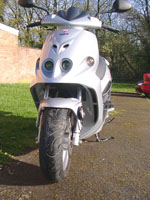
machines follow the same set of styling cues, the most obvious
being the twin projector headlamps and the digital instrument
panel, and in fact both are exactly the same overall length,
although strangely the 125 has a 10mm shorter wheelbase. Put
a 125 and a 200 side by side and apart from the badges by
the seat and some detail differences in the swingarm area,
you'd have a job to tell one from the other. Both
machines follow the same set of styling cues, the most obvious
being the twin projector headlamps and the digital instrument
panel, and in fact both are exactly the same overall length,
although strangely the 125 has a 10mm shorter wheelbase. Put
a 125 and a 200 side by side and apart from the badges by
the seat and some detail differences in the swingarm area,
you'd have a job to tell one from the other.
As far as fittings are concerned, there's
useful bag hook behind the front fairing for carrying those
essential supplies back from the supermarket, and a small
cubbyhole with a spring-loaded cover for the odd petrol receipt,
or maybe for a set of designer shades for that "cool-Italian"
look. There's also a panel that you can remove to get access
to the fuses and the coolant header tank for maintenance.
The three dial instrument cluster has
analogue petrol and water temperature gauges either side of
a central multi-function digital display. As well as giving
you engine revs and road speed, it can also show the time,
battery volts, air temperature, miles covered and how far
there is to go until the next service is due.
But like all scooters, the instruments
are mounted well below the eye-line for normal riding, so
you have to make a conscious effort to look at them. Not a
good idea when you're manoeuvering through traffic, when the
last thing you need to do is take your eyes off the road.
On the plus side the large bar-mounted mirrors give a superb
view of what's behind and to the side, so you'd be better
off looking at these rather than watching your speed and revs
as you fight you way to the front of the queue.
 In
order to keep the weight as low down as possible, Malaguti
have mounted the engines horizontally in both scooters, and
to further lower the C of G the fuel tank is underneath the
footboards. Both these factors as well as the comparatively
long wheelbase, go a long way to make the Phantom Max very
stable while on the move, although surprisingly the scooters
are still very maneouverable. In
order to keep the weight as low down as possible, Malaguti
have mounted the engines horizontally in both scooters, and
to further lower the C of G the fuel tank is underneath the
footboards. Both these factors as well as the comparatively
long wheelbase, go a long way to make the Phantom Max very
stable while on the move, although surprisingly the scooters
are still very maneouverable.
The fuel filler is behind a locking
cover between the footboards. There's a large amount of storage
space beneath the locking seat, in fact according to the labels
you can get two "Jet"-style open face helmets under
here. However, it's too shallow to hold even one full-face
helmet, but there again, can you imagine the syle-conscious
Italians wearing anything but an open-face helmet on a scooter?
The seat is well padded and there's plenty of room for both
the rider and pillion to travel in comfort. The pillion also
has excellent handholds either side of the tailpiece.
There's a useful security loop welded
to the frame on both scooters to make it easy to chain them
to large immovable objects, and they are also fitted with
both centre and side stands. However the starter won't turn
if the side stand's down, which I personally found a bit annoying
at times. A nice touch was the rear hugger which was a great
help in keeping a lot of the road dirt off the back of the
scooter.
Although there's little to distinguish
between the two sizes of scooter visually, get them both on
the move and that extra 75cc makes all the difference.
 Press
the starter button on the Phantom Max200
and there's no mistaking the fact that this is a single-cylinder
machine. There's plenty of low-down torque from the engine,
which allows the automatic clutch to bite at what seems very
low revs and pull away cleanly from rest. The throttle action
is very smooth and progressive, which makes for easy progress
both through the traffic and along the open road, but it's
also a lot of fun to give it a big handful away from the lights
and watch everything else disappear behind you as you sprint
up to around 50mph. Press
the starter button on the Phantom Max200
and there's no mistaking the fact that this is a single-cylinder
machine. There's plenty of low-down torque from the engine,
which allows the automatic clutch to bite at what seems very
low revs and pull away cleanly from rest. The throttle action
is very smooth and progressive, which makes for easy progress
both through the traffic and along the open road, but it's
also a lot of fun to give it a big handful away from the lights
and watch everything else disappear behind you as you sprint
up to around 50mph.
From here the acceleration eases off,
but the engine still pulls willingly up to around 70. At this
speed the front wheel feels planted and everything is solid
and stable. Past 70mph, and the acceleration really begins
to fall off as the digital speedo counts upward more slowly
than a clock ticks off the seconds. I managed to see 80mph
before having to back off and brake hard for a roundabout,
and there was probably a further 5-10mph left to come, given
another half-a-mile of dual carriageway. But the Max200 wasn't
really happy at this speed. The front was beginning to feel
a bit light and "skittish", probably due to the
"sail effect" of the my arms on the bars, and the
engine was starting to get out of breath, in spite of there
still being plenty of revs left on the dial. But this sort
of speed is not really what a scooter's all about, and you'd
be far better backing off to around 70, and it would cruise
all day at this speed, even two-up.
By contrast, the Phantom Max125 was a much
more revvy beast. It needed a good handful of revs to get
the clutch to bite although it still took up smoothly, launching
the scooter rapidly to around 40mph, and then slowing its
acceleration to around 55mph, before finally creeping up to
a maximum speed of 68mph. The smaller bike always felt stable
and planted at all speeds, which is not too surprising given
the similarities of the two chassis. Two-up riding made everything
a little harder work, and probably 55mph would be a good cruising
speed for the Max125.
 When
it came to stopping there was very little if anything
to choose between the two. The braking systems on both are
identical and as there's only 4kg difference in weight, there's
nothing really in it. The brakes were well able to cope with
the speeds that both scooters could do, and at 80mph the Max200
pulled up smoothly and firmly with only two fingers on each
lever and the usual rear-bias that's common to all scooters.
Although having said that, the front brake is surprisingly
effective on its own. When
it came to stopping there was very little if anything
to choose between the two. The braking systems on both are
identical and as there's only 4kg difference in weight, there's
nothing really in it. The brakes were well able to cope with
the speeds that both scooters could do, and at 80mph the Max200
pulled up smoothly and firmly with only two fingers on each
lever and the usual rear-bias that's common to all scooters.
Although having said that, the front brake is surprisingly
effective on its own.
Given their size, both scooters handled
very well, being maneouverable through the traffic and still
fast and stable out on the open road. They can be thrown around
corners with enthusiasm, but look out for the centre stand
touching down on left-handers, especially on the Max200. The
standard forks at the front, along with a conventional rear
swingarm with twin spring/damper units give a suspension system
that was firm yet compliant, and took bumps and road irregularities
in its stride. On one quick right-hander I hit a pothole at
around 45mph while well-leant over, and although I certainly
felt it through the bars, the Max200 stayed on track with
no shakes or shimmies. For two-up travel, there's a quick
and simple preload adjustment for the rear suspension.
The build quality of both models of
the Phantom Max was excellent. The paint finish was deep and
lustrous and everything was well bolted together with no squeaks
and rattles from the body panels on the bumpiest of surfaces.
And if you want your scooter to be a little different, you
can get it fitted with a luggage topcase, a windshield or
a windscreen, and an electronic alarm system
So if you're in the market for a "large"
scooter, then it's certainly worth looking at both of these
Malagutis. The only question is whether to go for the 125,
or pay the extra money for the larger 200cc model. The choice
is yours, but remember that they do say that there's no substitute
for cubic capacity!
DH
|